Annecy France Wedding Venues: Beyond Provence and Loire
-
myfrancewedding.com
- Destination WeddingsFranceWedding VenuesWeddings
- 16

Picture a lakeside terrace where the water is so clear you can see the stones on the bottom, the Dents de Lanfon catch the last gold of the day, and your guests are raising glasses of Apremont while swans drift past the private pontoon. This is Lake Annecy, and if you have spent months comparing Provençal estates and Loire châteaux without finding the one, the lake is the destination you may have been missing. Annecy France wedding venues occupy a category that does not exist anywhere else in the country: Alpine-lakeside, where snow-capped peaks rise behind turquoise water, where the cuisine is reblochon and Mondeuse rather than ratatouille and rosé, and where the architecture is Savoyard stone and timber rather than tuffeau and slate. What follows is the practical deep dive that the Instagram photographs do not provide.
Why Annecy: The Alpine-Lakeside Wedding You Haven’t Considered
Most couples researching French wedding regions exhaust Provence, the Loire Valley, and maybe Bordeaux before they encounter Lake Annecy. The lake sits at 447 metres altitude in the Haute-Savoie department, 40 minutes south of Geneva, ringed by mountains that rise to over 2,300 metres. It is the second-largest natural lake in France by surface area, covering 27 square kilometres, and it has a reputation as one of the purest lakes in Europe. That reputation is not marketing. Since 1957, a dedicated intercommunal syndicate called SILA has operated a ring of sewage collectors around the entire lake, intercepting wastewater from every lakeside commune and carrying it to a treatment plant outside the catchment. Nothing enters the lake. Continuous scientific monitoring has run since 1966, and the water transparency varies from 3 metres in summer to 12 metres in winter, with an annual average of 7.1 metres. The result is water so clean it supplies drinking water to more than 200,000 residents. When your wedding photographs show turquoise shallows and crystalline depth, that is not a filter. It is six decades of engineered purity.
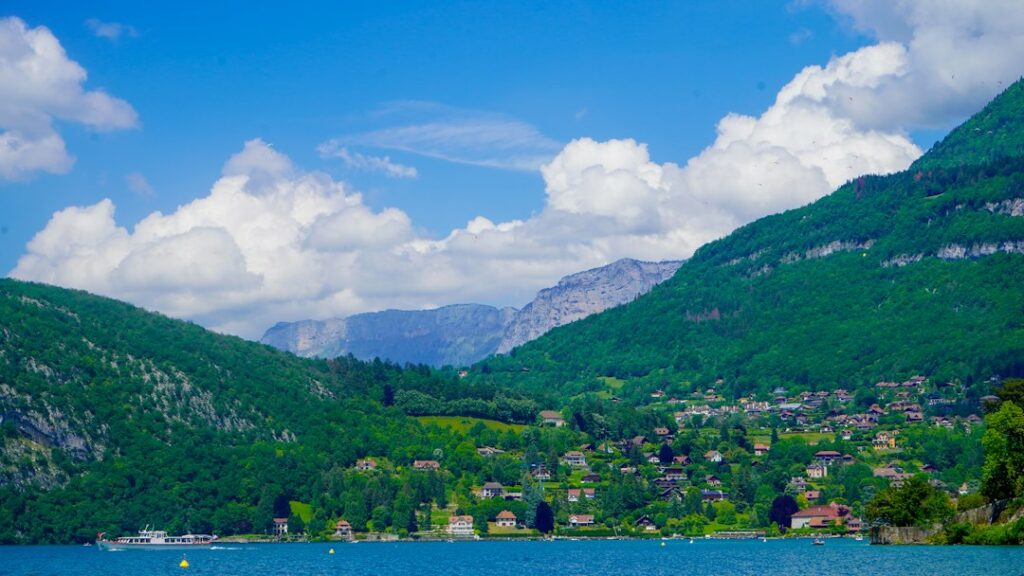
What makes Annecy distinct from every other French wedding region is the combination of two landscapes that normally exclude each other: a swimmer’s lake and a mountaineer’s alpine range, existing in the same frame. Provence gives you lavender and heat. The Loire gives you châteaux and flat river valleys. The French Alps give you peaks but no water. Annecy gives you both, and the effect is visually unlike anything in the south or the Loire. The mountains here are not distant silhouettes. La Tournette rises to 2,351 metres directly above the eastern shore, the Dents de Lanfon form a jagged saw-tooth ridge above Talloires, and the Semnoz frames the western side. Your ceremony photographs carry alpine drama behind lakeside serenity, a composition no Provençal mas or Loire château can replicate.
The cultural register is different too. This is Savoie, not Provence. The region was part of the Kingdom of Sardinia until 1860, and the architectural identity is Savoyard: thick stone walls, wooden balconies, pitched roofs, chalet proportions. The food is mountain food: reblochon cheese, diots sausages, tartiflette, Beaufort, fondues. The wines are Savoie AOC, made from grape varieties you will not find in any other wine region of France: Jacquère, Mondeuse, Altesse. A wedding here carries a different emotional tone than a Provençal celebration. It is warmer in feeling, more intimate in scale, and more rooted in a specific regional culture that most international guests will not have encountered before. If you are still mapping French regions to your vision as a couple, our guide to wedding locations across ten French regions places Annecy in context alongside the other major destinations. For a deeper Alpine comparison, our guide to Chamonix wedding venues covers the high-altitude alternative 90 minutes up the valley.
The practical case for Annecy is as strong as the aesthetic one. Geneva Airport is 40 minutes away by car, with a direct bus service that takes 50 minutes from the airport terminal to Annecy bus station. No internal flights, no ferry connections, no multi-train logistics. International guests land in Geneva and are lakeside by early afternoon, which makes Annecy one of the most accessible destination wedding locations in France for couples with guests flying from multiple continents. The travel friction that makes Corsica or the Dordogne exhausting for older attendees simply does not apply here.
Venue Types Around the Lake and Mountains
Annecy wedding venues divide into three categories that serve fundamentally different visions: lakeside hotels where your reception happens at the water’s edge, historic châteaux and Savoyard residences where the architecture is the story, and grand town venues for couples who want Annecy’s old-city character. The difference between these categories is not cosmetic. It determines your catering model, your accommodation capacity, your privacy level, and whether your guests experience a residential lakeside weekend or a single-evening reception in a convention-style hotel. Understanding which category fits your vision before you start comparing individual properties saves months of misdirected research.
| Venue | Type | Seated Capacity | On-Site Beds | Catering Model | Distance from Geneva |
|---|---|---|---|---|---|
| Abbaye de Talloires | Lakeside hotel, historic | 180 (marquee) | ~90 (37 rooms) | Imposed (in-house) | 50 min |
| Palace de Menthon | 5-star lakeside hotel | Up to 600 (Pavillon du Lac) | ~120 (66 rooms) | Imposed (in-house) | 45 min |
| La Croix des Champs | Savoyard residence, exclusive use | 130 (Le Pressoir) | 29 (9 suites) | Free choice of caterer | 45 min |
| Château de Menthon | 12th-century castle | 120 (wine cellar) | 8 (cottage) | External caterer | 50 min |
| Hôtel Beau Site, Talloires | Intimate lakeside hotel | 100 (off-season) | 15+ (rooms) | Imposed (in-house) | 50 min |
| Imperial Palace, Annecy | Grand town hotel | 600 (largest room) | ~180 (90 rooms) | Imposed (in-house) | 40 min |
Lakeside Hotels: Where the Water Is the Venue
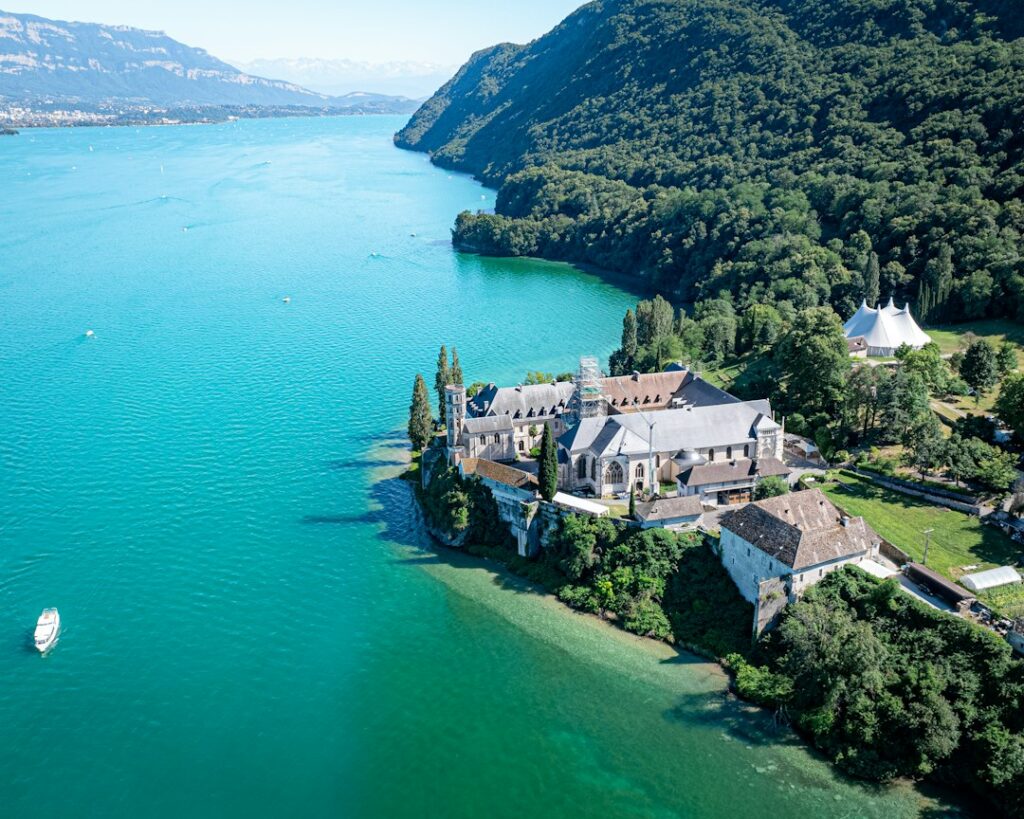
The lakeside hotel is the signature Annecy venue format. These properties sit directly on the shore, with private beaches, pontoon access for boat arrivals, and terraces where your cocktail hour unfolds over the water. They combine accommodation, catering, and ceremony space in a single location, which makes them the strongest structural fit for couples who want a residential weekend where every guest stays on-site and the celebration flows naturally from ceremony to dinner to dancing without anyone leaving the property.
Abbaye de Talloires is the venue most couples picture when they imagine a Lake Annecy wedding. A former 17th-century Benedictine monastery turned 4-star hotel and restaurant, it sits in what GEO Magazine called one of the most beautiful bays in the world, in the village of Talloires on the eastern shore. Ceremonies take place in the gardens overlooking the lake. Cocktails move to the terraces, which extend to the water’s edge with a private pontoon for boat arrivals. Dinner is served in an elegant marquee measuring 120 to 180 square metres that opens onto the gardens, with a maximum capacity of 180 guests. After dinner, the Ermengarde room hosts dancing until 2 AM, and from 2 AM the vaulted bar continues for up to 70 people in a stone-walled room that feels like it was built for slow conversations at the end of a long night.
The Abbaye has 37 rooms sleeping approximately 90 guests, and full privatization of all rooms is mandatory for any wedding with a dance evening. The catering is fully imposed: the Abbaye operates as a hotel and restaurant, so no external caterer is permitted. The wedding package includes cocktail reception, dinner, evening celebration, and next-day brunch as a complete package. Saturday weddings require a minimum of 80 adult guests from March through May and October, and 100 adult guests from June through September. Pricing listed on third-party platforms places the venue in the range of €35,000 to €80,000 depending on season, guest count, and menu selection, though the Abbaye provides tailored quotes directly. It is 15 minutes from Annecy by car or boat and approximately 50 minutes from Geneva Airport.
What it does well: the most atmospheric lakeside setting on Lake Annecy, with genuine monastery architecture, private pontoon access, and a service infrastructure built on decades of wedding experience. The vaulted bar for after-midnight gathering is a detail that elevates the entire evening. What to watch for: the imposed catering model means you are locked into the Abbaye’s culinary vision, and the marquee for dinner is a tent, not a permanent room. If your dream is a candlelit dinner in a stone hall, the marquee is a different aesthetic. The minimum guest counts also mean this venue is not suitable for intimate weddings under 80 people on summer Saturdays.
Palace de Menthon is the five-star alternative on the same stretch of shoreline, a 1900s-era palace hotel in Menthon-Saint-Bernard with 66 rooms and suites, including a private villa. The reception infrastructure is the most flexible on the lake: the Pavillon du Lac is a 900-square-metre space that can be configured into 15 separate rooms, scaling from an intimate dinner to a large-scale reception. Ceremonies can take place in the gardens, on the private beach, or with arrival by boat at the private marina. The hotel offers a full in-house catering service spanning wine receptions, cocktail parties, show cooking, buffets, plated meals, dessert tables, and next-day brunch. A spa with lake and mountain views gives guests a reason to stay on the property between events.
What it does well: the most comprehensive five-star infrastructure on Lake Annecy, with the largest configurable reception space, the highest accommodation capacity among lakeside hotels, and a spa that transforms the property into a genuine weekend retreat rather than just a wedding venue. What to watch for: pricing is arranged on request, and five-star palace hotels on Alpine lakes do not compete on price. If your budget is the determining factor, request a quote early and compare it against the Abbaye and La Croix des Champs before committing. The hotel’s scale also means it operates as a luxury hotel year-round, so confirm whether your booking delivers exclusive use of the reception spaces or whether other hotel guests will be on the property during your celebration.
Hôtel Beau Site Talloires is the intimate option, a confidential address in the same village as the Abbaye but deliberately scaled for smaller celebrations. Off-season, the hotel privatizes its restaurant, terraces, and Espace B for up to 100 guests with dancing until 2 AM. In high season, the format tightens to 72 guests to preserve what the hotel calls the intimacy and poetry of a lakeside wedding. A garden overlooking the lake hosts secular ceremonies, and a daytime wedding format is available for couples who want a lunch celebration extending into an afternoon on the beach and a lakeside cocktail at sunset. On-site accommodation requires booking a minimum of 10 rooms for larger weddings and 4 rooms for intimate ones.
What it does well: the strongest venue for couples who want a genuinely intimate lakeside wedding where the guest count stays under 100 and the celebration feels like a private gathering rather than a production. The daytime wedding format is distinctive and suits couples who prefer a relaxed afternoon celebration over a formal evening dinner. What to watch for: the high-season capacity of 72 guests is firm. If your guest list is growing, this venue is not the right fit. The accommodation requirement also means your guests are committed to staying on-site, which is a feature for some couples and a constraint for others.
Historic Châteaux and Savoyard Residences
Not every Annecy wedding venue is a hotel. The second category comprises historic properties that offer exclusive-use privatization without the full-service hotel infrastructure. These venues give you the architecture, the privacy, and the keys to the property for the weekend, but you build the catering and service independently. For couples who want creative control over the menu, the wine, and the design, this category is where Annecy’s most interesting options sit.
La Croix des Champs in Veyrier-du-Lac is the venue that best embodies the Savoyard residence format. An 18th-century property originally built as a vineyard with its wine press and barn, it has been restored by the same family that has occupied it for generations, combining noble materials and 800 square metres of space across three reception rooms. The Pressoir, a 145-square-metre room with the original wine press still in place, seats up to 130 guests for dinner with a view of the lake and the Semnoz mountain through the windows. The Chai, a 50-square-metre 17th-century vaulted stone cellar, serves as a cocktail or intimate dinner space. The property is fully privatized from Friday morning to late Sunday, becoming what the estate calls your family home for the weekend.
Accommodation spans 9 suites and bedrooms sleeping 29 guests, with capacity up to 33. A dedicated caterer’s kitchen with equipment is provided, and you are free to choose your own caterer, which is the defining advantage of this venue. Venue hire is listed from approximately €8,500 on third-party platforms, with pricing tailored by the estate directly. Additional accommodation is available within walking distance, including gîtes and hotels, for guests beyond the on-site capacity. The estate is served by the lake cycle path and is 100 metres from the Veyrier sailing club, with beach access on foot.
What it does well: the best balance of authentic Savoyard character, exclusive-use privacy, and catering freedom on Lake Annecy. The original wine press in the main reception room gives the space a specificity that no hotel ballroom can match, and the free-choice caterer model lets you design a menu that reflects your tastes rather than the estate’s. The Friday-to-Sunday privatization creates a genuine family-home weekend. What to watch for: 29 beds for 130 seated guests is a significant accommodation gap. Most of your guests will need nearby hotels or gîtes, and shuttle transport becomes a line item. The dry-hire model also means you are responsible for building the catering, rentals, and service from scratch, which requires a planner who knows the Haute-Savoie vendor landscape.
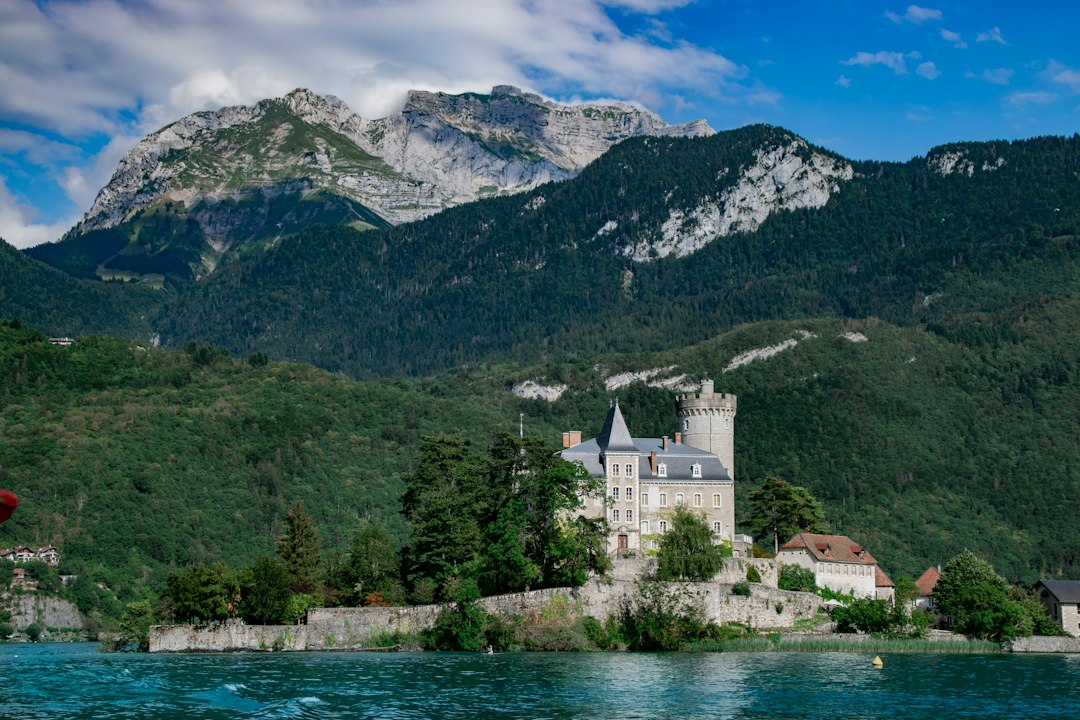
Château de Menthon-Saint-Bernard is the fairytale option, a 12th-century castle still occupied by the same family for nearly 1,000 years, perched above the lake with panoramic views of the water and surrounding mountains. Receptions take place in the 17th-century wine cellar below the castle, which accommodates up to 120 people. The terrace can host outdoor receptions with tents, and the estate includes a park, a vineyard with biodynamic vines replanted since 2018, and night illuminations. A cottage in the château outbuildings offers 4 suites sleeping 8 guests, with breakfast included.
What it does well: the most dramatic historic setting on Lake Annecy, a genuine medieval castle rather than a reproduction, with a private visit of the château available for your guests as part of the experience. The biodynamic vineyard on the property adds a wine dimension that other lakeside venues cannot match. What to watch for: the accommodation capacity of 8 is minimal. This is an event venue, not a residential estate. Your guests stay in hotels in Annecy or Menthon-Saint-Bernard, and the 20-minute drive from Annecy means shuttle transport is essential. The wine cellar reception space, while atmospheric, is a single room. If your vision requires separate spaces for ceremony, cocktail, and dinner, confirm whether the terrace and tent options provide enough flexibility.
The Grand Town Option: Imperial Palace
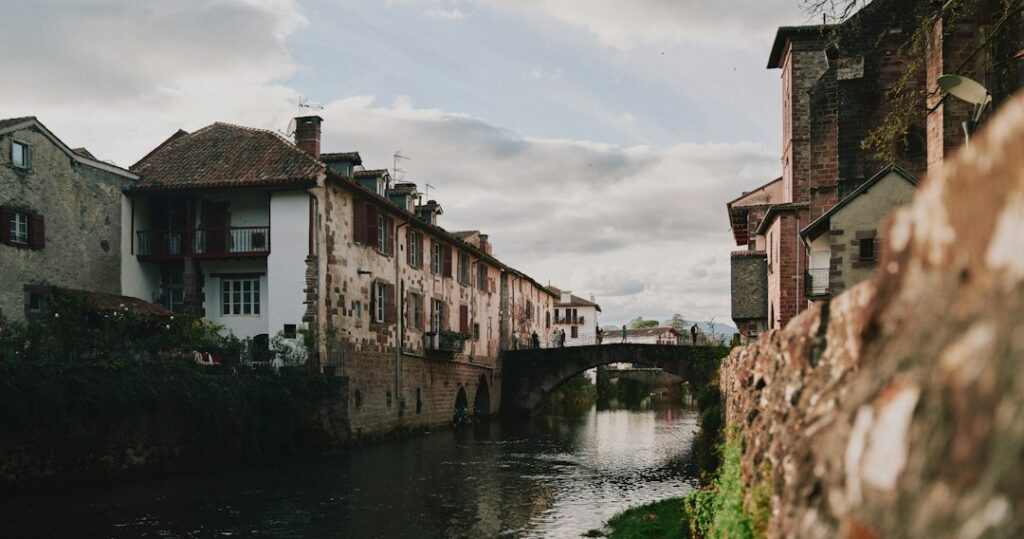
Not every couple wants a lakeside estate. Some want the energy of Annecy’s old town, with its canals, medieval streets, and the Palais de l’Île, a 12th-century fortress on the Thiou river that is one of the most photographed buildings in France. The Imperial Palace is the venue that bridges town and lake: a 4-star Edwardian-style hotel facing Lake Annecy, within a 15-minute walk of the old town, with 90 guest rooms and a congress centre containing 21 modular rooms. The largest room seats up to 600 people, making this the highest-capacity wedding venue in Annecy. Three restaurants, including a gastronomic restaurant with a lake-view terrace, provide the catering infrastructure.
What it does well: the most scalable venue on the lake, capable of handling a 600-guest reception or an intimate dinner, with the convenience of being walking distance from Annecy’s restaurants, shops, and old town. The 90 rooms mean most of your guests can sleep on-site, and the free public car parks with 600 spaces eliminate a logistics headache that rural venues create. What to watch for: the Imperial Palace is a convention hotel as well as a wedding venue. The 21 modular rooms are designed for conferences and banquets, not intimate celebrations. The building’s Edwardian grandeur is real but institutional, and the experience can feel closer to a luxury hotel wedding than a private lakeside celebration. For couples whose priority is the lake itself, a lakeside hotel in Talloires or Menthon delivers a more immersive setting.
Seasonal Reality: Working with an Alpine Calendar
The Annecy wedding season runs from June through September, and outside that window, the calculus changes significantly. The lake sits at 447 metres, which is moderate altitude, and summer temperatures in the Annecy valley typically range from 15 to 25 degrees Celsius. The surrounding peaks, however, remain snow-capped well into June on the higher summits, which is precisely what gives the lake its photographic drama: turquoise water below, white peaks above. The season is shorter than Provence or the Loire Valley, where May and October are viable outdoor months. In Annecy, May can be warm but unpredictable, and October brings autumn colour in the mountains but cooler evenings that push ceremonies and cocktails indoors.
July and August are peak tourist season on the lake. The cycle path that circles the entire 42-kilometre shoreline fills with cyclists and families. The beaches around Annecy and Sévrier draw day-trippers from Geneva and Lyon. Hotel rooms are more expensive and harder to book, and restaurant reservations require advance planning. This is the same dynamic that affects Provence in July and August, but Annecy’s tourist infrastructure is smaller than the Luberon’s, which means the pressure concentrates more intensely. If your heart is set on a July or August lakeside ceremony, book your venue and accommodation 12 to 18 months ahead, and reserve restaurant tables and guest rooms as early as you reserve the venue itself.
June and September are the sweet spots. The lake is warm enough for swimming in September, the tourist crowds thin, hotel rates ease, and the mountains still carry enough snow to provide the alpine backdrop. June offers long daylight hours, wildflowers in the alpine meadows above the lake, and the clearest water of the summer months, before the thermal stratification of July and August reduces surface transparency. September brings the most stable weather patterns of the season and the beginning of autumn colour on the deciduous slopes, which adds a amber-and-gold palette that July’s uniform green does not offer.
What every Annecy couple must plan for: mountain weather is less predictable than Mediterranean weather, even in summer. A lakeside ceremony in July can be 28 degrees and sunny, but a cold front can drop temperatures to 15 degrees with rain in the same week. Every outdoor venue on the lake needs a solid weather backup. The Abbaye de Talloires provides the Grande Galerie as an indoor ceremony and cocktail space. The Palace de Menthon has the configurable Pavillon du Lac. La Croix des Champs has the Chai vaulted cellar. But the Hôtel Beau Site and the Imperial Palace have less generous indoor options for ceremony-scale gatherings, so ask specifically what the indoor alternative is and whether it seats your full guest count before you commit.
One seasonal factor that no one mentions until it matters: the lake itself is a thermal regulator. Water temperatures in August can reach 24 to 26 degrees Celsius, which means evening air near the shoreline stays warmer than it does a few hundred metres inland. A reception on the lakefront in September may feel warmer than a reception in the hills above Annecy at the same date. If you are choosing between a lakeside venue and a hillside or town venue, the lake’s thermal mass works in your favour for evening celebrations extending past sunset.
Regional Flavours: Savoyard Cuisine for Wedding Feasts
The food at an Annecy wedding is not the food at a Provençal wedding, and understanding that difference is part of choosing the region. Savoyard cuisine is mountain cooking: rich, cheese-forward, built for cold evenings and physical exertion. The signature ingredients are reblochon, Beaufort, Tomme de Savoie, diots, crozets, and the potatoes and lardons that form the backbone of tartiflette. These are not novelty items added to a standard French menu for local colour. They are the regional culinary identity, and the best Annecy caterers know how to elevate them to a wedding standard without making your dinner feel like a ski-resort cafeteria.
The Cheese and the Dishes
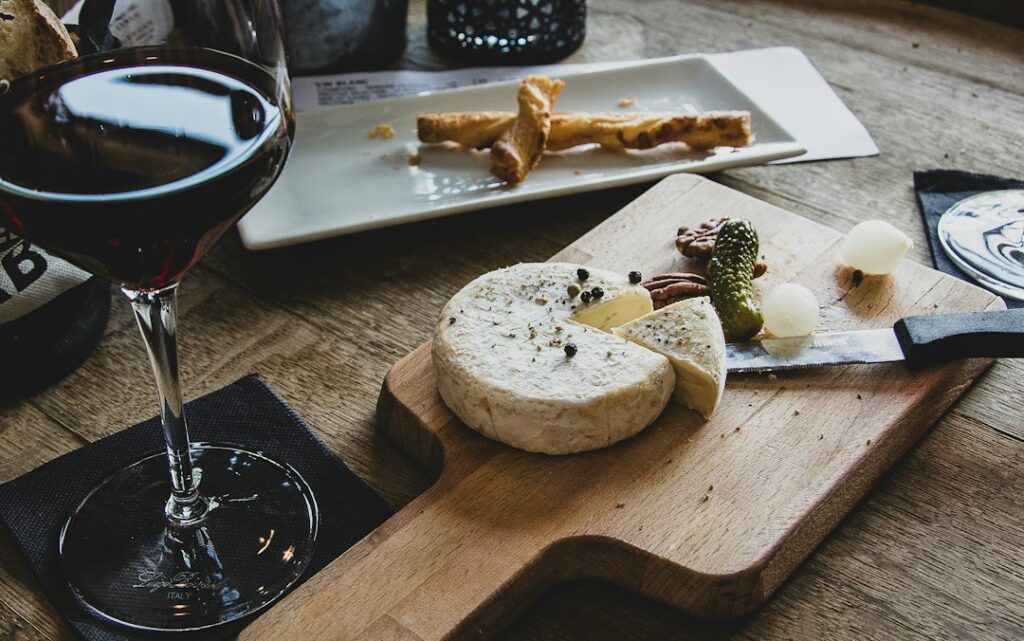
Reblochon de Savoie is the defining cheese of the Haute-Savoie. It carries an AOC and AOP designation, meaning its production is legally restricted to a specific geographical area and traditional methods. The cheese is a soft, washed-rind wheel made from raw cow’s milk, and its name comes from the Savoyard word reblocher, meaning to milk a second time. In the 13th century, Savoyard farmers paid their landowners based on milk yield, so they would under-milk the cows during the official measurement and then rebloche, milking a second time for their own use. The richer, second milking produced a higher-fat cheese that became reblochon. That cheese is the foundation of tartiflette, the dish most couples associate with a Savoyard wedding: potatoes, onions, lardons, and reblochon melted together in a giant poêle. Specialist caterers in the Haute-Savoie, such as La Poêle Savoyarde and La Poêle à Tartif, prepare tartiflette on-site in giant pans for events ranging from 50 to over 1,000 people, and the dish is served as a convivial, communal course rather than an individual plated one.
Tartiflette is not the only option. Croziflette is the lesser-known cousin, substituting crozets, small square buckwheat pasta traditional to Savoie, for the potatoes. Diots de Savoie are pork sausages seasoned with herbs and cabbage, cooked in white wine and served with polenta or boulangère potatoes. Beaufort, a hard cow’s milk cheese from the Beaufortain valley, appears on cheese boards and in fondues. Tomme de Savoie, a milder semi-hard cheese, rounds out the alpine cheese selection. The question for your caterer is not whether to include these elements but how to integrate them: a tartiflette station as a late-night snack after dancing, a diots course as the main, a Savoie cheese board replacing or supplementing the standard French cheese course. The best Savoyard caterers can do all of this at gastronomic level, and the worst will serve a generic French menu with a tartiflette option tacked on. Ask to see full tasting menus, not just ingredient lists.
Savoie Wines: Grape Varieties You Will Not Find Elsewhere
The wine story at an Annecy wedding is unlike any other French region. The Vin de Savoie AOC produces wines from more than 20 grape varieties, seven of which are unique to the region and grown nowhere else in the world. This means the wine list at your wedding is an opportunity to offer your guests something genuinely novel, not another Sancerre or Châteauneuf-du-Pape they have had a dozen times before.
The dominant white grape is Jacquère, which accounts for about 40% of the Savoie vineyard, roughly 800 hectares. Jacquère produces light, dry, crisp white wines with delicate floral and citrus flavours. The most famous appellations are Apremont and Abymes, both grown on the limestone scree of the Mount Granier collapse near Chambéry. An Apremont is the wine you want for the cocktail hour: bright, refreshing, low in alcohol, and perfectly suited to alpine air and lakeside heat. For richer white wines, Altesse, also known as Roussette de Savoie, produces fuller-bodied whites with more structure, suitable for the dinner course.
The red grape is Mondeuse, an indigenous Savoie variety covering roughly 240 hectares. Mondeuse produces medium-weight reds with attractive raspberry and violet aromas and a firm, slightly rustic structure with forest-floor notes. It is not a Burgundy Pinot Noir and should not be judged as one. It is its own wine, and it pairs naturally with the cheeses and sausages of the region. For a sparkling option, Crémant de Savoie offers a traditional-method sparkling wine made from Altesse, Jacquère, and Chardonnay grapes, providing a local alternative to Champagne for your toast.
The practical question for your caterer or sommelier: can you build a wine pairing entirely from Savoie AOC wines across cocktail, dinner, and toast? The answer is yes, and doing so gives your wedding a culinary coherence that ordering generic French wines cannot match. A suggested progression: Apremont or Abymes for the cocktail, Roussette de Savoie for the fish or cheese course, Mondeuse for the meat course, and Crémant de Savoie for the toast. If your venue operates an imposed catering model, like the Abbaye de Talloires or Palace de Menthon, ask specifically whether Savoie wines are featured on their wine list or whether you can supply your own. At the Abbaye, a corkage fee structure exists for receptions of 50 adults or more, allowing you to bring your own wine for a service charge. At La Croix des Champs, where you choose your own caterer, the wine selection is entirely yours.
Guest Experience: From Geneva Airport to Lakeside
The guest experience is where Annecy outperforms most French wedding destinations. Geneva Airport is approximately 42 kilometres from Annecy, a drive of 40 to 50 minutes depending on your venue’s location around the lake. A direct bus service runs from Geneva Airport bus station to Annecy bus station in approximately 50 minutes, departing hourly. There is no need for internal flights, ferry connections, or multi-leg train journeys. For guests flying from North America or Asia, Geneva offers direct long-haul connections and is a major international hub. The travel friction that makes Corsica, the Dordogne, or rural Languedoc exhausting for older guests simply does not apply here.
Once guests arrive, the lake provides a built-in activity programme for a multi-day weekend. The 42-kilometre cycle path circles the entire shoreline, with bike rentals available in Annecy and at multiple points around the lake. Swimming is possible from public beaches and from private hotel beaches at the lakeside properties. Sailing, windsurfing, and paddleboarding are available at clubs along the shore, including the Veyrier sailing club 100 metres from La Croix des Champs. Boat tours depart from Annecy and from Talloires, and guests can arrive at the Abbaye de Talloires by boat via the hotel’s private pontoon. The paragliding launch sites above Annecy, at Col de la Forclaz, are among the most spectacular in Europe. For a weekend format, your guests have more to do within a 15-minute radius of the lake than they would at most rural château estates.
The Accommodation Gap
As with every French wedding venue, the gap between how many guests a venue seats for dinner and how many it beds for the night is the single most consequential logistical fact. The Abbaye de Talloires seats 180 and sleeps 90, which means up to 90 guests need off-site accommodation. La Croix des Champs seats 130 and sleeps 29, leaving over 100 guests to find nearby lodging. The Palace de Menthon’s 66 rooms represent the strongest accommodation-to-reception ratio on the lake, but even there, a 200-guest wedding means roughly 80 guests need hotels elsewhere.
The good news is that Annecy has a substantial hotel infrastructure, from the Imperial Palace in town to smaller hotels and chambres d’hôtes in the lakeside villages. The challenge is that July and August are peak tourist season, and lakeside hotels fill with holidaymakers, not just your wedding party. If your guest count exceeds the on-site capacity of your venue, reserve hotel blocks 9 to 12 months ahead for summer dates. Talloires, Menthon-Saint-Bernard, and Veyrier-du-Lac have limited accommodation within walking distance of the lakeside venues, so shuttle transport between the venue and Annecy hotels becomes a necessary line item, typically costing €1,500 to €4,000 for a weekend depending on the number of transfers and the distance.
The VAT Question at Lake Annecy
The French VAT structure applies at Lake Annecy exactly as it does across the rest of France, and it catches the same international couples off guard. Venue hire, equipment rental, and all alcoholic beverages carry 20% VAT. Catering and food service carry 10% VAT. A venue quoting €25,000 HT for a weekend exclusive use becomes €30,000 TTC. A caterer quoting €12,000 HT becomes €13,200 TTC at the food rate. Across 10 to 15 vendor invoices, the cumulative VAT typically adds €3,000 to €8,000 that couples did not anticipate.
Always confirm whether an Annecy venue quote is HT (hors taxes, before VAT) or TTC (toutes taxes comprises, VAT included) before building your budget. Hotel-venue quotes are frequently presented HT, particularly for the venue hire component, while per-person catering packages at hotel venues may be quoted TTC. At La Croix des Champs, where you choose your own caterer, the venue hire and the catering are separate invoices with separate VAT rates. Ask your planner to present all figures TTC so you are comparing real costs, not pre-tax ones. For a broader discussion of how VAT works across French wedding regions, our guide to choosing your French wedding region covers the HT-to-TTC transition in detail.
One Annecy-specific note: because the Haute-Savoie borders Switzerland, some couples consider using Swiss-based vendors or sourcing wine and supplies from Geneva. Cross-border VAT rules apply differently than domestic French transactions, and Swiss VAT rates differ from French ones. If you are considering this route, confirm the VAT treatment with your planner or accountant before committing, as the savings on purchase price may be offset by import VAT and customs complications.
Annecy is not Provence with a lake. It is a fundamentally different kind of French wedding, shaped by alpine geography, Savoyard culture, and a body of water so clean it supplies drinking water to a quarter of a million people. The couples who end up with the celebration they imagined are the ones who understand that the lake is both the setting and the logistics: the same purity that makes the water turquoise is the result of six decades of engineered infrastructure, the same mountains that frame your ceremony photographs dictate a shorter season and a weather plan, and the same Savoyard identity that makes the food distinctive means your caterer needs to know how to cook at gastronomic level with reblochon and diots, not just plate a standard French menu. Get those decisions right, and Lake Annecy gives you something no Provençal estate or Loire château can replicate: a wedding where the water is clear, the peaks are snow-capped, and the wine in your glass comes from a grape variety that grows nowhere else on earth.
For couples exploring smaller-scale celebrations, our guide to small wedding venues in France includes intimate options across multiple regions. For those weighing the outdoor elements, our guide to outdoor wedding venues that master the elements addresses weather planning strategies that apply directly to lakeside ceremonies. Your French love story is waiting to unfold.
Frequently Asked Questions
What makes Lake Annecy different from Provence or the Loire Valley for a wedding?
Lake Annecy combines a swimmer’s lake with alpine mountain peaks in the same frame, which no other French wedding region offers. The cultural identity is Savoyard rather than Provençal, with chalet architecture, reblochon-based cuisine, and Savoie AOC wines made from grape varieties unique to the region. The lake’s water purity is engineered through six decades of sewage management by SILA, making it one of the cleanest lakes in Europe.
When is the best time of year for a Lake Annecy wedding?
June and September are the ideal months, offering warm weather, thinner tourist crowds than July and August, and lower hotel rates. July and August bring peak tourist season with higher accommodation costs and more competition for venue dates. The season runs from June through September, with October viable but cooler for outdoor ceremonies.
How far is Lake Annecy from Geneva Airport?
Geneva Airport is approximately 42 kilometres from Annecy, a 40 to 50 minute drive depending on your venue’s location around the lake. A direct bus service runs from the airport to Annecy bus station in about 50 minutes. No internal flights or ferry connections are needed, making it one of the most accessible French wedding destinations for international guests.
What types of wedding venues are available around Lake Annecy?
Annecy venues fall into three categories: lakeside hotels like the Abbaye de Talloires and Palace de Menthon with on-site catering and accommodation, historic properties like Château de Menthon and La Croix des Champs offering exclusive-use privatization with external caterers, and the Imperial Palace in Annecy town for large-scale receptions up to 600 guests.
Can we incorporate Savoyard food and wine into our Annecy wedding menu?
Yes. Reblochon de Savoie AOP, tartiflette, diots sausages, and Beaufort cheese are regional specialties that skilled Haute-Savoie caterers can elevate to wedding standard. Savoie AOC wines offer grape varieties found nowhere else in the world, including Jacquère whites like Apremont, Mondeuse reds, and Crémant de Savoie for the toast. Venues with imposed catering may feature these on their wine list, while free-choice caterer venues like La Croix des Champs let you build the pairing entirely.